👋 Hi welcome to my blog.

I’m Michiel Piscaer, a cloud and infrastructure engineer. I have a passion for learning and sharing knowledge about technology.

  • On Sapiolab I will write what will happen on my IT lab.

  • I will write on various topics. My first goal of the lab is to have a IPv6 only k8s cluster that runs Openstack.

🖥️ Installing Kubernetes — Phase 2

After installing Ceph and Kubernetes, In this article, I continue with the installation of Kubernetes and OpenStack ☁️. This turned out to be a journey with quite a few hurdles😤 along the way. #Kubernetes #digitalsovereignty #OpenStack #IPv6 #CloudComputing #DevOps #Homelab #ARM ...

January 5, 2026 · Michiel Piscaer

Installing the nodes with Ceph and Kubernetes

Network 🌐 In this post, I’ll walk through how I install and prepare the host nodes. Each host is set up with both Ceph and Kubernetes (K8s). The full configuration code on what I base this blog post about can be found at https://codeberg.org/mpiscaer/myOpenstackCluster with GIT tag 0.1.1 As described in my previous blog post, 📡 My First Network Connectivity, the network is fully routed. In most cases environments uses LACP to create a redundant network connection and where multiple hosts are on the same broadcast network. I deliberately chose not to use LACP on the interfaces and instead rely on OSPF and BGP to provide redundancy. In the end I use this setup to evaluate if this a usable setup. The advantage of using BGP and OSPF over LACP is beter integration of the network and hosts, traffic can flow directly and uses the shortest path. Using a layer 3 only setup eliminates the need for Spanning tree and so all links can stay active. I have three nodes, all three nodes will and up with the function: Ceph MON Ceph OSD Ceph MGR Kubernetes control node Openstack control node Openstack Compute node #Kubernetes #k8s #Ceph #IPv6 #Homelab #OpenStack #CloudNative #DevOps ...

December 19, 2025 · Michiel Piscaer

📡My first network connectivity

I am setting up an IPv6-only homelab with Forgejo, OpenTofu + Terragrunt, MikroTik switches, and BIRD3 OSPFv3 routing. A Forgejo runner operates inside the homelab and configures the network using Infrastructure-as-Code. The entire IoC configuration is publicly available on Codeberg. #IPv6 #Homelab #Forgejo #OpenSource #MikroTik #OSPF #OpenTofu #Terragrunt #BIRD #Automation ...

December 6, 2025 · Michiel Piscaer

ArmSoM Sige7 — First Impressions & Setup Note

Just received my new ArmSoM Sige7 and started testing the provided Ubuntu 22.04 image and Rockchip loader. Flashed the board, set up the system, and ran initial CPU stress tests. Power usage looks great: ~7.5W under full load and ~2.5W idle, with temps staying cool and the fan barely audible. Promising start for this RK3588-based board! #ArmSoM #Sige7 #RK3588 #SingleBoardComputer #SBC #Linux #Ubuntu #Homelab #ARM #TechNotes #SelfHosting ArmSoM Sige7 — First Impressions & Setup Notes Today, I received my ArmSoM Sige7 single-board computer, and I couldn’t wait to dive into setting it up and testing its performance. This post details my first impressions, the setup process, and the results of some early benchmarking. ...
November 25, 2025 · Michiel Piscaer

How I do my backup

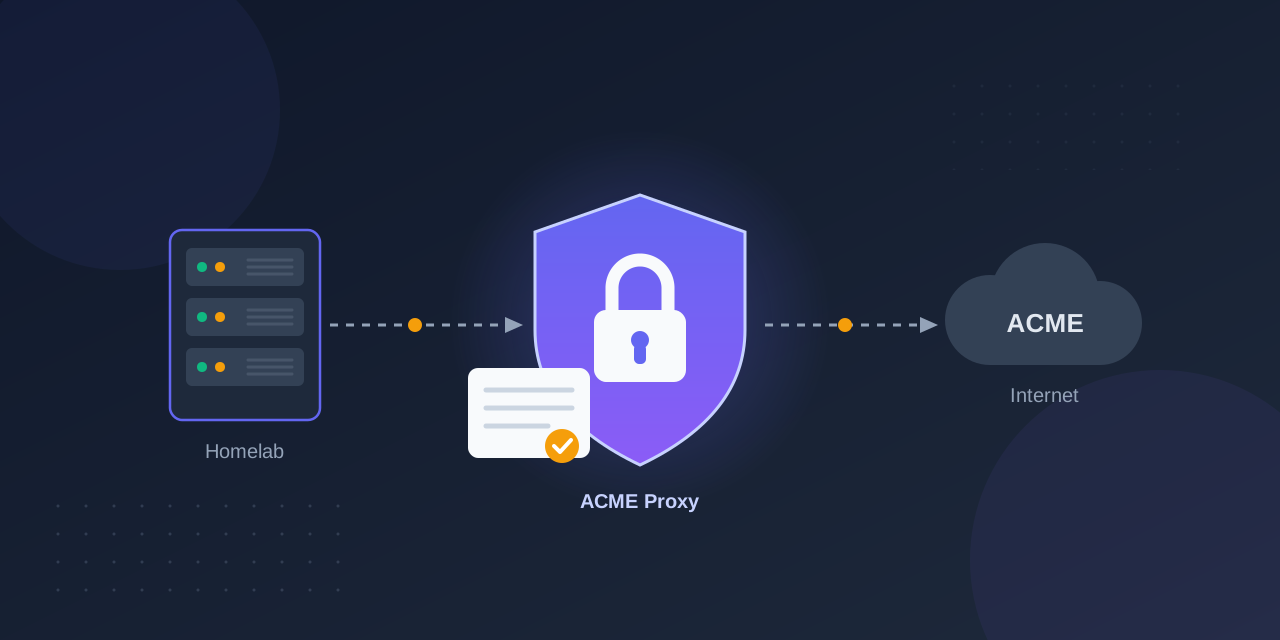
TL;DR: I back up my homelab using Snapper snapshots, an external dual-bay dock, weekly disk rotation, encryption, and a Hue lamp that shows the backup status. How I do my backup On my homelab server, I’ve got a bunch of LXC containers running on a Btrfs filesystem. Snapper takes care of making hourly snapshots for me. I wrote a little backup script that sends those snapshots to an ACT Dual Bay Docking Station—basically an external dock that can hold two hard drives. ...

November 18, 2025 · Michiel Piscaer

Building my ARM-Based Homelab

Summary: I’m building a low-power ARM homelab running Kubernetes on an IPv6-only routed network. I’ll experiment with Open-Xchange, OpenStack, VXLAN, and AI frameworks like PyTorch and TensorFlow. #homelab #arm #kubernetes #openstack #openxchange #ipv6 #bgp #ospf #vxlan #mikrotik I’m planning to build a low-power ARM-based homelab that can optionally run Android. The main environment will be a Kubernetes (k8s) cluster operating on an IPv6-only backend network. The underlay network will be fully routed using OSPF or BGP, providing redundancy without relying on LACP. ...

November 15, 2025 · Michiel Piscaer